The art of rock candy cultivation, a delicate fusion of culinary craftsmanship and geological principles, has captivated confectioners and scientists alike for centuries. This ancient technique transforms humble sugar syrup into glittering crystalline structures through a process mirroring the formation of minerals deep within the Earth's crust. Unlike commercial sugar production, which prioritizes speed and volume, traditional rock candy artisans employ time-honored methods that celebrate the natural beauty of sucrose crystallization.
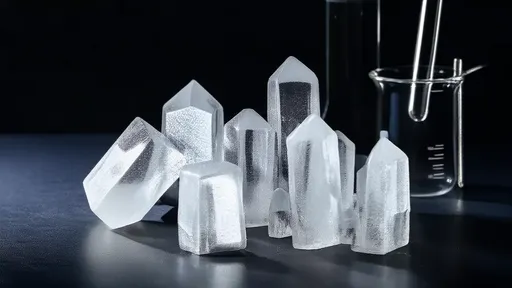
The geological foundations of rock candy formation reveal striking parallels with gemstone creation. When supersaturated sugar solutions cool slowly, molecules begin aligning themselves into orderly lattice structures - nearly identical to how quartz forms from silica-rich solutions in hydrothermal veins. Master sugar artisans manipulate variables like temperature gradients, viscosity, and impurity levels with the precision of geologists studying igneous intrusions. The resulting crystals' clarity, size, and morphology depend entirely on these carefully controlled conditions, making each batch as unique as naturally occurring mineral specimens.
Traditional cultivation begins with creating an exceptionally pure sucrose solution, heated precisely to 115°C to achieve optimal supersaturation. Artisans then suspend rough cotton strings or wooden dowels into the mixture, providing nucleation sites just as mineral seeds facilitate crystal growth in nature. Over the following 7-10 days, temperature fluctuations must remain within a 2°C range to prevent flawed crystallization. The slow cooling process allows sugar molecules to arrange themselves into perfect monoclinic crystal systems, sometimes growing to astonishing sizes of 5-7 cm in length.
Modern crystallography has deepened our understanding of these edible geodes. Advanced imaging techniques reveal that premium rock candy develops concentric growth zones similar to agate banding, with alternating layers of dense and porous crystalline structures. These microscopic variations account for the characteristic crunch and gradual dissolution profile prized by gourmet chocolatiers and mixologists. Some avant-garde confectioners now experiment with introducing controlled impurities - food-grade minerals like calcium or magnesium - to create colored bands mimicking natural gemstone formations.
The most skilled practitioners have adapted techniques from mineralogy to enhance their craft. By rotating cultivation vessels during the crystallization period, they achieve more uniform crystal growth akin to the tumbling process in gem polishing. Others employ seismic vibration damping systems to protect delicate formations from disruptive vibrations, just as museum conservators safeguard mineral collections. These methods yield translucent crystals with refractive indices approaching 1.54 - remarkably close to quartz - giving premium rock candy its signature sparkle when catching the light.
Environmental factors play a crucial role in successful cultivation. Humidity must remain below 40% to prevent syrup dilution through atmospheric absorption, while air circulation patterns affect crystal morphology. Some traditional workshops still position their curing rooms according to seasonal wind patterns, believing these subtle air currents influence crystalline structure. Scientific analysis confirms that laminar airflow does indeed promote symmetrical growth, creating the geometrically perfect pyramids that distinguish handcrafted rock candy from mass-produced varieties.
Contemporary applications of this ancient craft extend far beyond sweeteners. Molecular gastronomy chefs utilize geological crystallization principles to create edible centerpieces resembling mineral collections. Pharmaceutical researchers study rock candy formation to improve drug crystallization techniques. Even the aerospace industry has shown interest, as the microgravity environment of space stations offers unique conditions for studying pure sucrose crystallization without Earth's gravitational interference.
The future of artisanal rock candy may lie in hybrid techniques combining ancestral wisdom with cutting-edge science. Several European confectioners now use spectrophotometers to monitor crystal growth at molecular levels, while Japanese artisans employ ultrasonic cleaners to remove microscopic imperfections during development. Yet despite these technological advances, the essence of the craft remains unchanged - a patient collaboration between human ingenuity and nature's crystalline architecture, yielding edible jewels that delight both the palate and the eye.
By /Jul 7, 2025
By /Jul 7, 2025

By /Jul 7, 2025

By /Jul 7, 2025

By /Jul 7, 2025
By /Jul 7, 2025

By /Jul 7, 2025

By /Jul 7, 2025

By /Jul 7, 2025
By /Jul 7, 2025
By /Jul 7, 2025
By /Jul 7, 2025

By /Jul 7, 2025
By /Jul 7, 2025

By /Jul 7, 2025
By /Jul 7, 2025
By /Jul 7, 2025

By /Jul 7, 2025

By /Jul 7, 2025

By /Jul 7, 2025
